Silverado
Silverado cares for people living with Alzheimer’s and other forms of dementia through memory care communities, at-home care, and hospice, running roughly 55 locations across seven states when I was working on it.
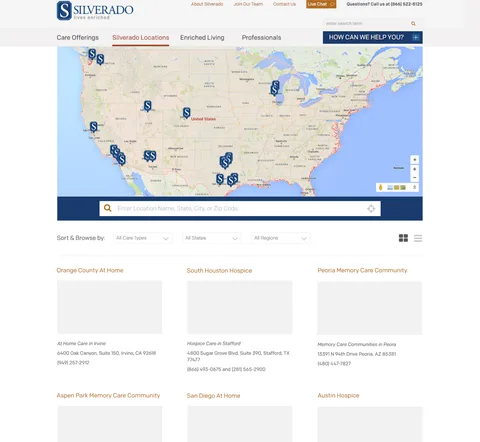
I was brought in to modernize the content architecture and the frontend, starting with the location map and the location detail pages. Some highlights:
- Fixed Templates to a Component Library. The site had been built the way most Umbraco sites were built then (i.e., each page type had its own Razor template). I replaced that with a library of reusable components. Silverado got flexibility they did not have before, and it cost them less over time, since a component built for one page could be reused on the next instead of rebuilt. This became the standard way we built Umbraco sites at Rhythm.
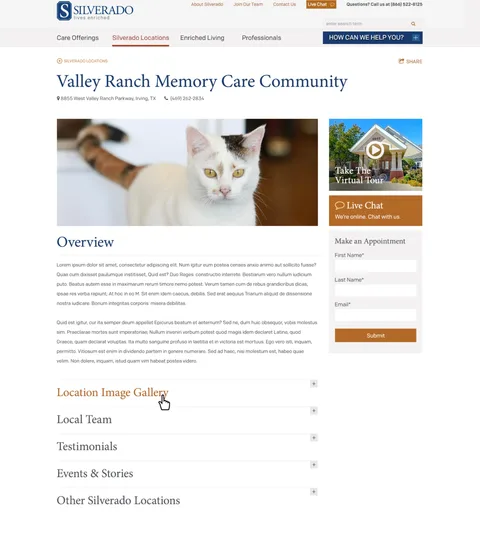
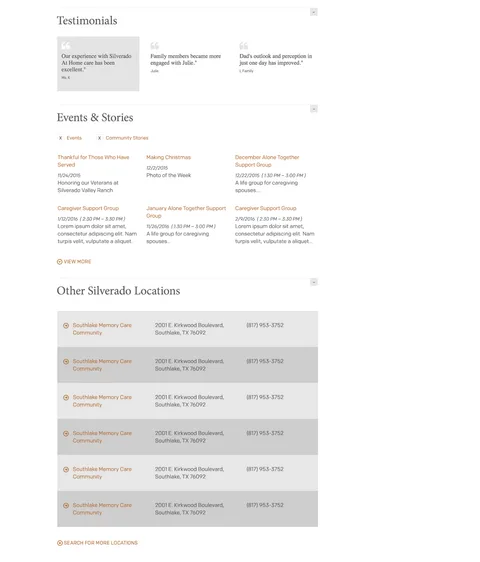
- Location Detail Pages. Rebuilt as a stack of components: a banner, body content with a sidebar, a slideshow, an image gallery, rich text, accordions, the local care team, testimonials, events and stories, nearby locations, and a virtual tour. Since these are components rather than a fixed template, a location that has testimonials shows them and one that does not simply leaves that section out.
- Two Systems Running Side by Side. Converting every page in one pass was not practical, so the old and new had to coexist for a long stretch. The same script bundle shipped both the legacy frontend and the new component frontend together, and pages moved across a section at a time rather than in a single cutover.
- A Base for the Rest of the Site. Starting with locations was not only about fixing the location pages. It produced a working component set and a content model that the rest of the site could then be converted against, which is what happened over the subsequent months.
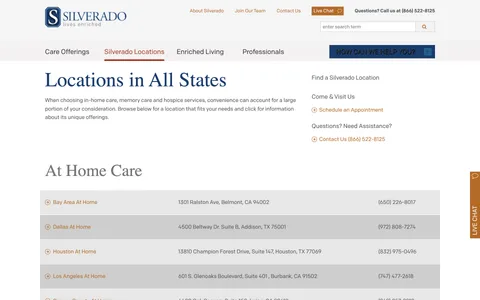
Below are the designs I worked from, alongside the fixed-template pages they replaced: